

Quick answer
When to clean gutters in Tacoma, WA: Twice a year is the minimum: once in May after the spring seed and blossom drop, and once in September before the rain settles in. If Douglas fir, cedar or big-leaf maple hangs over your roof, plan on three cleanings, because conifers shed all year. The September visit matters most, since Tacoma gets about 76 percent of its yearly rain between October and March, so a September cleaning lands ahead of the season and a November one is already inside it. Call (253) 777-1572 or book your cleaning online.
The numbers behind the schedule
What Tacoma’s rain data says about timing
Most gutter advice says “twice a year” and stops there. Our rainfall answers the when much more precisely than that.
Using NOAA’s 1991 to 2020 climate normals, Tacoma averages 40.8 inches of precipitation a year. It does not arrive evenly. July averages 0.6 inches and August 0.8. Then the line bends hard: September 1.6, October 4.1, November 6.5 and December 6.0.
Add up October through March and you get 31.0 inches. That is about 76 percent of the year’s rain falling in six months, with the other six months splitting the remaining quarter. That is the whole case for timing your cleaning instead of picking a random Saturday.
The rain is steady more than it is violent. November’s 6.5 inches come across roughly 19 wet days. That sounds gentle until you remember a gutter does not get a day off in between. A clog that would cause one bad afternoon in a dry climate becomes a leak that runs for weeks here.
The deadline nobody tells you about
Look at the jump from September to October. Rainfall goes from 1.6 inches to 4.1, and October alone averages 15 days with precipitation. That is not a slow slide into fall. It is a switch flipping.
The City of Tacoma confirms it from a different direction. The city moves its street sweepers onto the leaf-season schedule “starting the third week in October,” leaving the fixed residential routes because of how many leaves come down. If leaf volume is a citywide problem by the third week of October, your gutters have been collecting the same debris for weeks, and the heaviest rain of the year is days away.
That is why we say a cleaning booked for September is preventive, and one booked for late October is remedial. It is the same service with a very different result. In September the debris is dry and light, the ladders are on dry ground, and the downspouts get flushed before they have to carry anything. In late October the crew is pulling a wet, heavy mat out of troughs that have already overflowed a few times.
Month by month
The Tacoma gutter calendar
What is happening on your roofline each month, and the one thing worth doing about it.
| Month | Avg. rain | What is happening up there | What to do |
|---|---|---|---|
| January | 6.0 in | Peak rain, about 20 wet days | Watch how the gutters handle a real storm |
| February | 4.0 in | Still wet, wind damage starts to show | Look for sagging runs and new overflow spots |
| March | 4.4 in | Rain tapering, moss still growing | Book your spring service |
| April | 3.4 in | Buds, catkins and maple seed coming down | Wait out the drop before cleaning |
| May | 2.0 in | Seed and blossom drop finishes | Spring cleaning, visit one |
| June | 1.4 in | Dry season begins | Good window for repairs |
| July | 0.6 in | Driest month, debris bakes into the trough | Best month for new installs |
| August | 0.8 in | Fir needles piling up quietly | Look from the ground and book fall service |
| September | 1.6 in | Rain returns, needles heavy | Fall cleaning, visit two |
| October | 4.1 in | Leaf drop peaks, about 15 wet days | Last call, schedules are full |
| November | 6.5 in | Wettest month, about 19 wet days | Storm checks and downspout clearing only |
| December | 6.0 in | Standing water, about 20 wet days | Clear downspouts if anything overflows |
Why spring waits until May
People want to clean the moment the sun comes out in March. Hold off. April is when buds, catkins and big-leaf maple seed come down, and a gutter cleaned in early April is often half full again by May. Cleaning once the drop is finished means one visit does the job instead of two.
Why summer is for building, not cleaning
June through August is the driest stretch of the year, which makes it the best time for the work that needs dry wood and dry ground: rehanging sagging runs, replacing rotted fascia, sealing seams and putting up new seamless gutters. If your spring cleaning turned up something that needs fixing, the summer window is when our gutter repair and installation crews can do it without chasing the weather.
Frequency, honestly
How many cleanings your house actually needs
The right number depends less on the calendar than on what is growing over your roof.
Twice a year: open lots and distant trees
For most Tacoma homes on an open lot, or with trees that stand back from the roofline, two visits do it. Clean in May after the spring drop finishes and again in September before the rain. That covers the two big debris loads and puts the system in good shape for the wet season.
Three times a year: conifers overhead
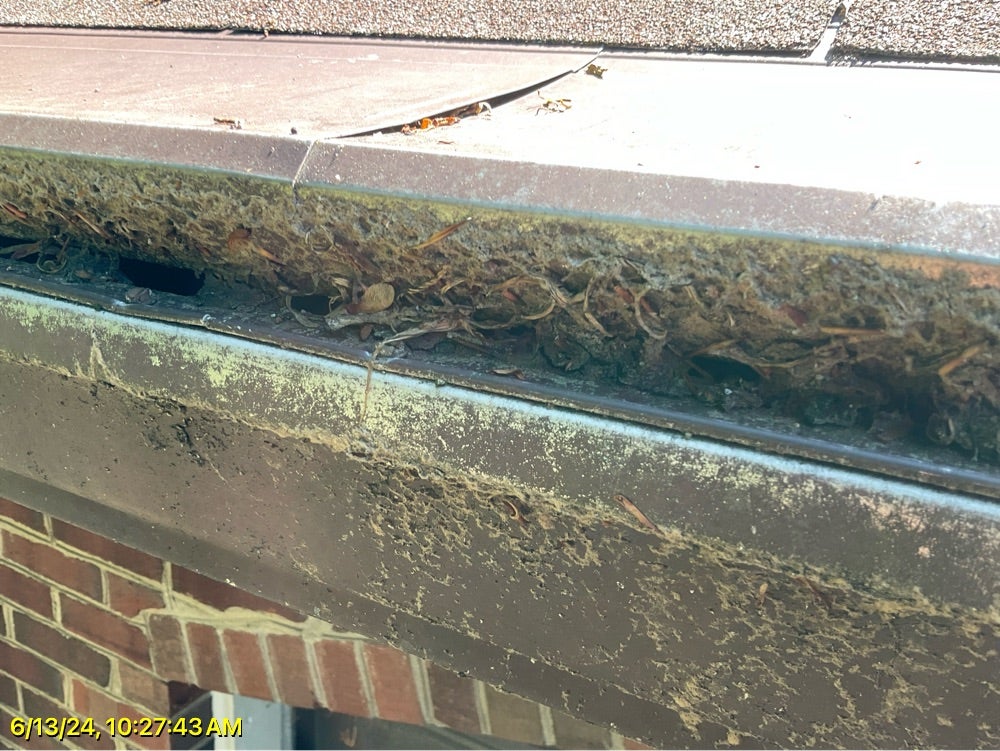
If Douglas fir, cedar or pine sits directly over the house, three is the realistic number. Conifers do not have a tidy drop season. They shed needles all year, and needles are worse than leaves because they pack into a dense mat in the bottom of the trough instead of sitting loosely on top. Add a midwinter check to the May and September visits. Our guide to fir needles, cedar flagging and big-leaf maple explains why each one behaves the way it does.
Four times a year, or a guard
Heavy mixed tree cover, a roof valley that funnels debris into one spot, or a two-story roofline that makes your own checks unsafe can push you to four visits. At that point you are paying for cleanings often enough that a guard starts to make sense. We run the numbers in are gutter guards worth it in Tacoma.
Signs your schedule is not keeping up
- The gutters overflow within a few weeks of being cleaned.
- Seedlings, grass or moss are growing out of the trough by midwinter.
- One downspout runs hard while another on the same side barely drips.
- Mildew or drip lines show up on siding below a single section every winter.
- You find needle mats at the outlets even after a fall cleaning.
- The ground at one corner of the house stays soft all season.
One thing to say plainly: cleaning more often does not fix a gutter that is pitched wrong or short on downspouts. If yours overflow within weeks of a cleaning, the problem is the system, not the schedule. That might mean re-pitching a run, adding an outlet, or sizing up to a 6-inch gutter on a roof plane that is too big for what is there.
Scheduling in the South Sound
Book before the rain, not during it
Everyone calls the same week. The homeowners who get the convenient date are the ones who called before anything looked wrong.
Here is the practical side of this trade in the Pacific Northwest. The phones start ringing the week of the first real storm, usually mid to late October, and by then the calendar is already tight. The people who got their pick of dates booked in August or September. If you are reading this in summer, that is good news. You still have room to choose.
A simple year for a Tacoma homeowner
- August: look and book.Walk around the house, note any sagging or staining, and get on the fall schedule.
- September: fall cleaning.Troughs cleared by hand and downspouts flushed before the October switch.
- October to December: storm walk.Step outside during a steady rain once and watch every corner and downspout.
- January to February: wind check.After the big blows, look for runs pulled loose or knocked out of line.
- May: spring cleaning.Once the seed and blossom drop finishes, clear the trough again.
- June to July: fix what you found.Repairs and new gutters go up in the dry window.
What if you are already late?
An October or November cleaning is still worth doing. You are behind the curve, not out of luck. The crew will be pulling heavier, wetter debris, and the downspout flush matters even more because plugs have had time to form at the elbows. If water is already coming over the edge, tell us that when you call, and we will put the worst runs first. Through the winter our crews handle overflow and clogged downspouts as storm calls, but the cleanest result always comes from getting ahead of the season.
If you would rather not track any of this, the maintenance program puts your home on a schedule timed to the needle drop and the rain, so the calendar takes care of itself. Every visit through our gutter cleaning service covers every run and every downspout by hand, with a look at hangers and fascia while the ladder is already up. We schedule cleanings across Tacoma, University Place, Bonney Lake and the rest of the South Sound.
Pick your fall window while there are still windows to pick. Call (253) 777-1572
Schedule a CleaningA local reminder that costs nothing: when you see the city’s leaf-season sweepers come through in the third week of October, your gutters are full of the same leaves. If you have not had them cleaned by then, call that week.
Frequently Asked Questions
Twice a year: once in May after the spring seed and blossom drop finishes, and once in September before the wet season starts. September is the more important of the two, because Tacoma gets roughly 76 percent of its yearly rain between October and March. Homes under conifers should add a midwinter cleaning.
Twice a year is the minimum for most Tacoma homes. Three times is more realistic under Douglas fir, cedar or pine, because conifers shed needles year round and needles pack into the bottom of the trough. Heavy mixed tree cover or a roof valley that collects debris can justify four visits or a guard.
Late summer through September. The debris is dry and easy to clear, the ground is firm for ladders, and the work lands before October, when Tacoma’s average rainfall jumps from 1.6 inches to 4.1 inches. Waiting for the rain means clearing a wet, heavy mat during the season instead of ahead of it.
Not too late to be worth doing, but you are behind. The City of Tacoma moves its street sweepers to the leaf-season schedule the third week of October because of leaf volume, and gutter schedules fill up that same week. An October cleaning still helps. September is the window you actually want.
Yes. When a gutter overflows or a downspout plugs between November and March, it should be cleared right away rather than left until spring. Expect heavier, wetter debris and a focus on outlets and elbows, where winter clogs form.
Because April brings buds, catkins and big-leaf maple seed. A gutter cleaned before that drop is often half full again by May. Waiting until the drop finishes means one spring visit covers it.
A good fine mesh guard turns several cleanings a year into an occasional check, because needles and leaves stay on top of the mesh. It does not mean zero attention. A yearly look and a light brushing in shady spots keep the mesh flowing.
Free estimates
Ready to get your Tacoma gutters cleaned before the October switch?
Free, no-pressure written estimates from local Solutionists. Every run cleared by hand, every downspout flushed, and a recurring schedule timed to the needle drop if you never want to think about it again.
The Brothers That Just Do Gutters · Tacoma · (253) 777-1572 · Serving Tacoma, WA and the South Sound
Licensed, Bonded & Insured · Washington Contractor License #BRTHRBT745J1