

The Brothers That Just Do Gutters · Tacoma
Commercial Gutters in Tacoma
Warehouses and distribution space near the Port, older brick storefronts downtown, retail centers, medical offices, churches and apartment buildings from Tacoma and University Place out to Puyallup and Federal Way. Seamless commercial runs formed on site, repairs that hold through an eight month wet season, and scheduled service your property manager can plan around.
- Licensed & Insured
- Seamless Runs Formed On-Site
- Pierce & South King
- Locally owned in Tacoma
- W-2 crews, never day labor
- Free written scope
Quick answer
Commercial gutters in Tacoma:The Brothers That Just Do Gutters, Tacoma installs, repairs, cleans and maintains commercial gutter systems on warehouses, retail centers, office and medical buildings, churches and multifamily properties across Tacoma, University Place, Puyallup, Federal Way and the rest of the South Sound. Seamless aluminum and steel runs are formed on site in 6 inch and 7 inch profiles, and maintenance visits are scheduled around needle drop and the wet season. Estimates are free. Call (253) 777-1572 or book a walkthrough online.
Built for buildings, not houses
Commercial rooflines fail differently
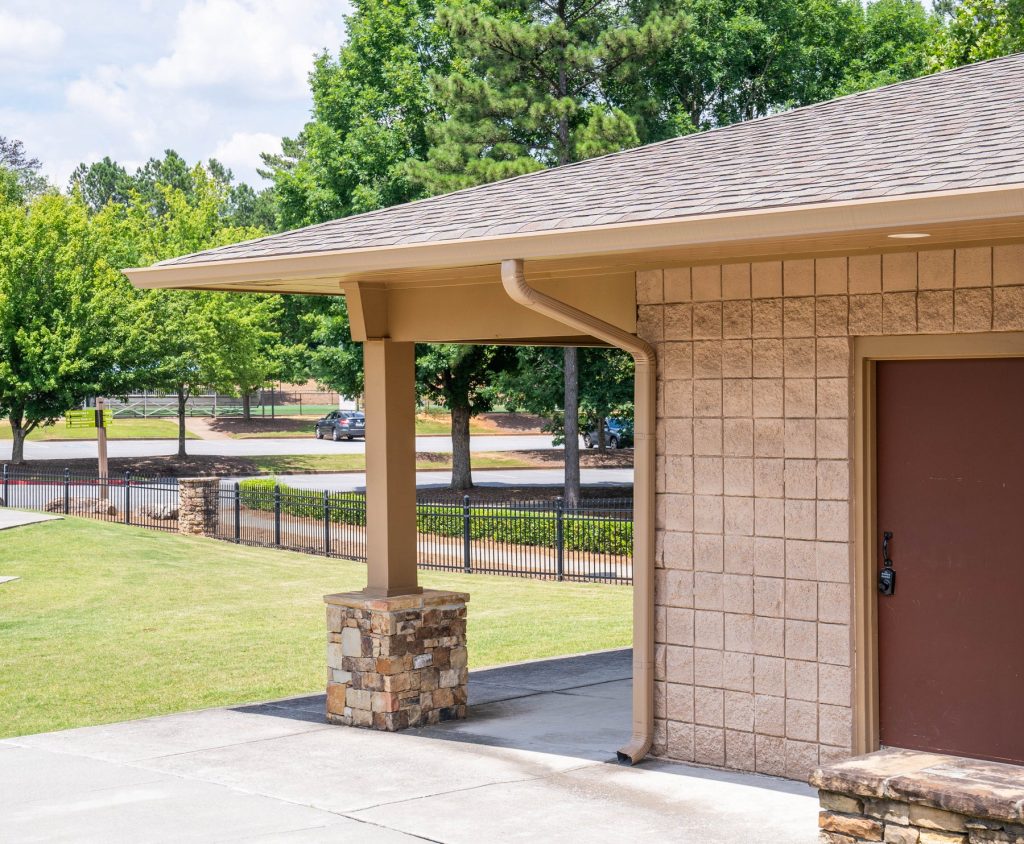
A house sends a few hundred square feet of roof through a 5 inch trough. A distribution building or a retail strip can send ten times that through a run nobody looks at until it is sheeting over a doorway. Around here the rain does not arrive in one violent hour, it arrives for eight months, and a trough packed with fir needles and moss never gets a chance to dry out. We size the system for the roof that is actually there and for the debris that is actually falling on it.
- Sized from real roof area and South Sound rainfall, not a default profile
- 6 inch and 7 inch seamless runs formed on site, so long walls get fewer seams
- Added and oversized downspouts where the math calls for them
- Heavier gauge and coated fasteners where salt air off the water reaches the building
Sizing and capacity
Your gutters are too small for the building
Most of the overflow we get called out for is not a one-off clog. It is a system that was never big enough for the roof above it. A builder puts a residential 5 inch profile and a couple of outlets on a long, shallow roof plane, and it holds up fine until the rain settles in for three days straight.
The fix is arithmetic before it is labor. We measure the contributing roof area, work out what it has to carry when an atmospheric river parks over the South Sound in November, and then size the trough and the number of outlets to match. Sometimes that means a 7 inch run. Often it just means three more downspouts in the right places.
We form the runs on site, so a hundred foot wall gets one continuous piece instead of sections joined every twenty feet. Fewer seams is fewer future leaks, and in a climate where those seams sit wet for most of the year that matters more here than almost anywhere.
Specification
Residential vs commercial
This is the difference between a gutter that survives a Tacoma winter and one that gets replaced in three years.
| What we look at | Typical residential | What a commercial building needs |
|---|---|---|
| Trough profile | 5 inch K-style on most homes | 6 inch standard, 7 inch on long or low-slope roof planes and anywhere the contributing area is large |
| Downspout size | 2 by 3 inch | 3 by 4 inch or larger, sized to the outlets rather than to what was on the truck |
| Outlet count | One per 30 to 40 feet is common | Calculated from roof area and sustained rainfall, which usually means more outlets than the original build had |
| Hanger spacing | 24 to 36 inches | Tightened, because a full commercial run carries serious weight and the fascia behind it stays damp most of the year |
| Material | .027 aluminum is typical | Heavier gauge aluminum or steel, with coated fasteners anywhere salt air off the water reaches the building |
| Seams | Sections joined as needed | Formed on site in one continuous run wherever the wall allows, because every seam is a future leak |
| Maintenance | Once or twice a year | Scheduled, documented visits tied to needle drop and the tenant calendar, with photos after each one |
| Paperwork | A receipt | Written scope, photo record and damage documentation you can hand to an owner, a board or an insurer |
Commercial services
What we handle on commercial rooflines
One local crew for the whole system, from the trough to where the water leaves the property.
Seamless 6 inch and 7 inch runs formed on site and sized to the roof area above them.
Learn more Commercial RepairLeaking seams, sagging runs, pulled hangers and wind damage, documented as we go.
Learn more Cleaning & Maintenance PlansScheduled visits with photos and notes, built around needle drop, moss growth and the wet season.
Learn more Downspouts & DrainageMore outlets, larger downspouts and tightline routing that moves water off the property and meets city stormwater rules.
Learn more BroGuard Gutter GuardsFine metal mesh built for fir needles and cedar flagging, so the trough stays clear between visits.
Learn more Fascia & Roof EdgeIf the board behind the gutter has gone soft, hangers will not hold. We fix the edge too.
Learn more 7 Inch Commercial ProfilesWhen a 6 inch trough cannot carry what the roof above it produces, we step up to 7 inch with oversized outlets.
Learn more Specialty MetalsCopper, galvanized and heavier gauge stock for churches, historic downtown storefronts and elevations that have to look right.
Learn more Free estimateRequest a Commercial QuoteSend us the building and what is going on with it. A local Solutionist walks the roofline, measures the runs and leaves a written scope and price you can take to an owner or a board. No pressure, no obligation.
Book a site walkthrough or call (253) 777-1572Diagnostics
Six signs your system is undersized, not just dirty
Cleaning fixes a clog. None of these are clogs, and cleaning will only buy you a season.
- 1It sheets over the front edge in a steady rain
A clogged gutter overflows at the clog. An undersized one overflows evenly along the whole run, usually right over an entrance or a walkway. That is a capacity problem, and no amount of cleaning changes it.
- 2Staining or streaking down the wall below the trough
Vertical marks under the gutter line mean water has been going over the edge regularly, not once. On masonry, brick and stucco that staining is the early warning before you get real damage.
- 3Hangers pulling loose or spacing that has opened up
Commercial runs are heavy when full, and here they stay full for months. If the hangers are spaced like a house or the fascia behind them has gone soft from sitting wet, the run starts to sag and the slope stops working.
- 4Water pooling at the base of the building
Standing water near the foundation, or a downspout that just dumps onto the slab, means the system is moving water out of the gutter but not away from the property. That is a drainage fix, not a gutter fix, and in Tacoma it is a stormwater question too.
- 5Moss growing in the trough itself
Not on the roof, in the gutter. Once moss takes hold it holds water against the metal all winter, traps every needle that lands on it and quietly eats the finish. That is a system that never gets a chance to dry out.
- 6Water dumping onto walkways, docks and parking
A downspout that empties where people walk or park is not just a puddle. It is a slip claim in December, algae on the pavement by February and asphalt that fails years early. Commercial water has to be carried away from the building, not just off the roof.
Maintenance plans
Maintenance your property manager can plan around
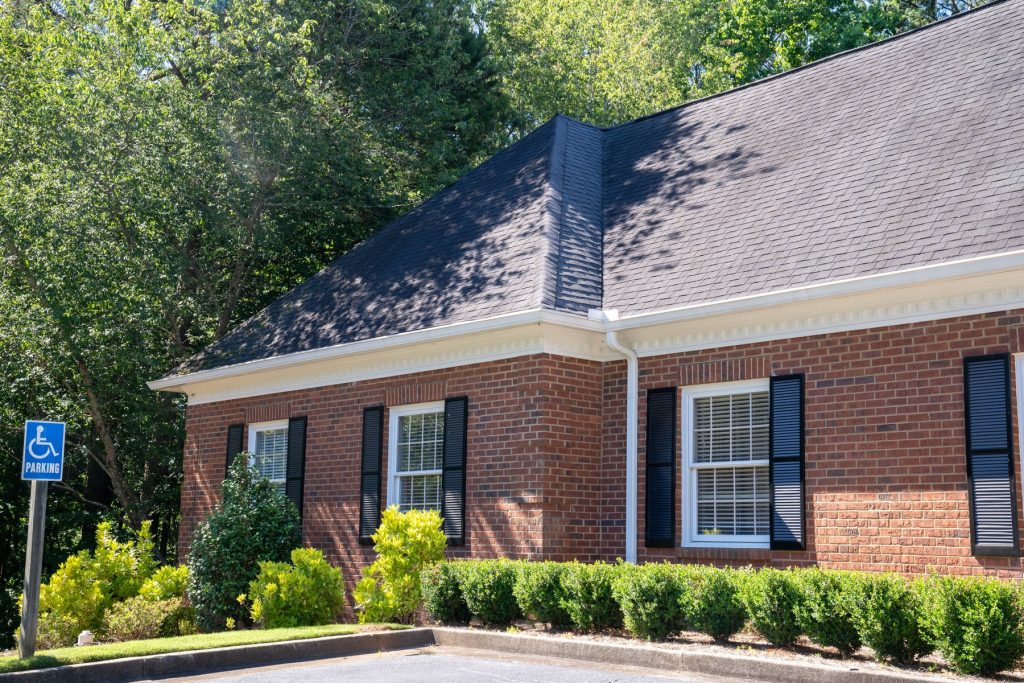
Commercial gutters rarely get attention until something goes wrong, and by then the damage is usually fascia, soffit or an interior ceiling tile rather than the gutter itself. A plan turns that into a line item you can budget instead of an emergency you cannot.
Ours runs on the local calendar. Fir needles and cedar flagging come down through late summer and autumn, so the heavy clean lands before the rain settles in. We come back midwinter to check that everything is still draining, because that is when the system has to work for weeks at a time. Every visit comes with photos and notes on what we found.
If you manage several buildings, you get one point of contact and one set of records across all of them. No chasing three different crews for three different properties.
Property types
Commercial properties we work on
The Port, Fife and Sumner are full of long, low-slope rooflines with enormous contributing area and very few downspouts.
Brick and masonry along Pacific Avenue, Hilltop and 6th Ave, much of it still running whatever gutter went up decades ago.
Shared rooflines, tenant turnover and walkways underneath. Overflow here is a liability question as much as a building one.
Apartment communities across Tacoma, Puyallup and Federal Way, where one failing run turns into a stack of maintenance tickets.
Steep roofs, tall elevations and volunteer maintenance. These are the buildings most often working with original gutters.
Patient entrances, covered walkways and parking that has to stay dry and safe when it has been raining for three days.
Year-round
The commercial gutter year in the South Sound
What we are doing on commercial rooflines across Pierce and south King County each season, so the system is ready before the weather asks it to work.
- Spring · Mar to MayDrying out and repair
The first real window to fix what the winter exposed. Sagging runs, pulled hangers and seams that opened up get repaired, photographed and written up.
- Summer · Jun to AugInstall and resize season
The dry window for new seamless runs, added outlets and tightline drainage. If a building needs to go from 5 inch to 6 or 7, this is when it happens.
- Fall · Sep to NovHeavy clean and guard installs
The most important visit of the year. Fir needles and cedar flagging come down, troughs get cleared, outlets are flushed and tested, and BroGuard fine mesh goes on the properties that keep clogging.
- Winter · Dec to FebWet season checks
Slope, seams and outlets checked while the system is actually working. Standing water in a badly sloped run is what pulls a commercial gutter off a building here.
How commercial work runs
How a commercial job runs
- 1Call or send the address
Tell us the building and what is happening. A local Solutionist answers, not a call center in another state.
- 2On-site walkthrough
We measure the runs, check the roof area feeding them, look at the fascia and see where the water is actually going.
- 3Written scope and number
You get the recommendation in writing with the reasoning behind it, so you can take it to an owner or a board without translating it.
- 4Work scheduled around you
Early mornings, weekends or between shifts. We keep entrances and docks clear and leave the property clean.
Straight answer on pricing
What drives the number
We are not going to put a price per foot on a web page, because the honest answer is that two buildings the same size can be very different jobs. Here is what moves it, so you can walk into the walkthrough already knowing what we will be looking at.
- Total linear feet and how the walls break up. One long uninterrupted elevation is faster and cleaner than the same footage broken into eight short returns.
- Profile and material. 6 inch aluminum sits at one end. 7 inch, heavier gauge or steel sits at the other. The roof above decides which one is right, not the budget.
- Height and access. Single story with clear parking is straightforward. Three stories over a landscaped bed or an active loading dock is a different day of work.
- How many outlets and where they can go. Adding downspouts is usually the cheapest real fix on an undersized system, but where they can land depends on doors, drives and grade.
- Whether the fascia is sound. If the board behind the gutter has gone soft, new hangers have nothing to hold. We will tell you at the walkthrough rather than after we have started.
- Drainage at the bottom.Dumping water at the slab is cheap and creates a foundation problem. Tightlining it away costs more, ends the issue and keeps you right with the city.
Estimates are free, written and carry no pressure attached to them. If a larger scope needs to be phased across a budget year, say so at the walkthrough and we will scope it that way.
Why the Brothers
Why property managers and building owners call us
Not roofing with a gutter crew attached. The whole company is built around the roofline, which is why we catch sizing problems a general contractor walks past.
Background-checked W-2 crews. The people on your property are on our payroll, insured under our policies, and they will be the ones back next season.
The truck makes the gutter in your parking lot to the exact length of your wall. That is how a hundred foot elevation ends up with no seams in it.
Measured scope, clear reasoning and photo documentation. Enough detail that you can forward it to an owner or a board without having to explain it.
Commercial gutter questions we get
We work on warehouses and distribution space near the Port, older brick storefronts downtown, retail centers, medical offices, churches and apartment buildings. Our crews cover Tacoma and University Place out to Puyallup and Federal Way.
Six inch is our standard on commercial buildings, and long or low-slope roof planes often step up to 7 inch. The deciding numbers are the roof area feeding each run and the outlets it needs, since South Sound rain settles in for days rather than one hard hour. We measure both before recommending anything, and sometimes the fix is more downspouts rather than a bigger trough.
A clogged gutter overflows at the clog, while an undersized one overflows evenly along the whole run in steady rain. Other signs include streaks on the wall below the gutter, hangers pulling loose and water pooling at the base of the building. Cleaning will not fix any of those.
Yes. Maintenance plans include scheduled, documented visits with photos and notes after each one, built around needle drop, moss growth and the wet season. If you manage several buildings, you get one point of contact across all of them.
Background-checked W-2 employees, never day labor. The Tacoma team is licensed, bonded and insured in Washington under Contractor License #BRTHRBT745J1 and locally owned, and you reach one local number rather than a call center. Every service visit is photo-documented, so you have a record to hand to an owner, a board or an insurer.
Yes. Where salt air off the water reaches the building, we use heavier gauge aluminum or steel and coated fasteners. Hanger spacing is tightened too, since a full commercial run is heavy and the fascia behind it stays damp most of the year. Call (253) 777-1572 to book a walkthrough.
Coverage
Where we work
- Auburn
- Bonney Lake
- Browns Point
- Burien
- Des Moines
- Eastside
- Edgewood
- Federal Way
- Fife
- Fircrest
- Kent
- Lake Tapps
- Lakeland Hills
- Lea Hill
- Midland
- Milton
- Normandy Park
- North End
- Northeast Tacoma
- Pacific
- Puyallup
- Ruston
- South Hill
- South Tacoma
- Stadium District
- Sumner
- Tacoma
- University Place
- West End
- Algona
- Dash Point
- Hilltop
- Old Town
- Proctor
Free commercial estimates
Get a real number on your building
Free walkthrough, measured runs and a written scope you can hand to an owner or a board. Licensed, fully insured, and worked by background-checked employees who will be back next season too.
The Brothers That Just Do Gutters · Tacoma · (253) 777-1572 · Serving Tacoma, Pierce County and the South Sound
Licensed, Bonded & Insured · Washington Contractor License #BRTHRBT745J1